18 Facts About the Golden Circle That Might Surprise You
The parliament older than most nations, the geyser that named the rest, and the falls one woman saved.
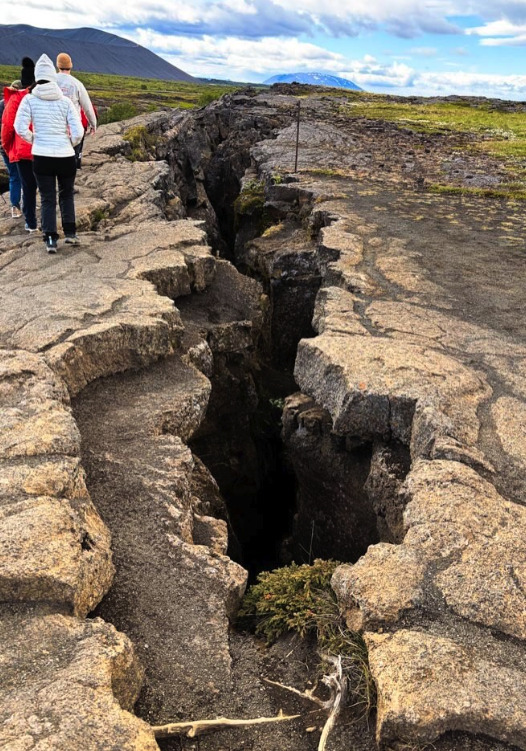
Most people drive the Golden Circle for the scenery and leave without knowing half of what they saw. These eighteen facts are the ones that make travellers stop and look again — each specific to this route, not general Icelandic trivia. Where a fact touches history or geology it's the same detail a good guide will tell you on the day.
1. The word "geyser" came from here
The original Geysir, in the geothermal field the route stops at, is where the English word "geyser" comes from — every geyser on Earth is named after this one spring. It's the rare case of an Icelandic place name entering everyday English.
2. You walk between two continents
At Þingvellir you descend into the rift where the North American and Eurasian tectonic plates pull apart — roughly a couple of centimetres a year. The valley is literally widening under your feet as you walk it.
3. Iceland's parliament met here from 930 AD
The Alþing — one of the world's oldest surviving parliaments — first convened on the plain at Þingvellir in 930 AD and met there for centuries. People rode days across the country to gather at the Lögberg, the Law Rock, making this quiet field one of the most important sites in Icelandic history.
4. Strokkur, not Geysir, is the one that performs
The famous Geysir rarely erupts now. The reliable show is its neighbour Strokkur, which fires a 15–20 metre column every few minutes — so the "geyser" almost every visitor photographs is not actually the one that named them all. Geysir itself has stirred back to life before — a series of earthquakes in 2000 briefly reactivated it — but Strokkur is the dependable performer.
5. A farmer's daughter saved Gullfoss
In the early 20th century Gullfoss was slated to be dammed for hydroelectric power. Sigríður Tómasdóttir, daughter of the landowner, campaigned fiercely against it and even threatened to throw herself into the falls. The waterfall you photograph today was protected largely because of her.
6. Gullfoss means "golden falls"
The name comes from the golden-brown tint the glacial Hvítá river takes on in certain light, thrown up in the spray. On a clear afternoon with the sun behind you, rainbows form in the mist below the lower tier.
7. The route was invented for tourists — in the 1930s
"The Golden Circle" isn't ancient. It was coined in the 1930s when the road linking Þingvellir, Geysir and Gullfoss became Iceland's first organised sightseeing circuit. The stops are old; the loop as a concept is less than a century old.
8. Kerið is about 3,000 years old
The crater most tours add as a fourth stop formed roughly 3,000 years ago. Its steep sides are red volcanic scoria, and the lake at the bottom shifts between blue and green depending on the light and the mineral content — a young feature by geological standards. Unlike most craters its lake sits below the water table rather than being rain-fed, which is why it never fully dries out.
9. The whole loop is under four hours of driving
For all the ground it seems to cover, the Golden Circle is only about 250 km round trip and under four hours behind the wheel in total. That compactness is exactly why it works as a single day out from Reykjavík rather than an overnight trip.
10. The sites are free — the tour is the cost
Þingvellir, the Geysir area and Gullfoss are all free to enter (Þingvellir charges only for parking). What you pay for on a tour is the transport, the guide and any extras like the Kerið fee or a lagoon ticket — not the sights themselves.
11. It links to Iceland's most famous spas
The Golden Circle is the anchor for Iceland's best-known soaks: many tours bolt on the Blue Lagoon or the quieter Secret Lagoon at Flúðir, turning a sightseeing loop into a sightseeing-and-spa day.
12. Þingvellir is a UNESCO World Heritage Site
Þingvellir was added to the UNESCO World Heritage list in 2004 — not for its scenery but for its history, as the site of the Alþing and a symbol of Icelandic identity. It's one of only a handful of Icelandic sites with that status, and most visitors walk it without realising.
13. You can snorkel between two continents
The Silfra fissure at Þingvellir is filled with glacial meltwater so clear that visibility runs to around 100 metres, and it sits directly in the gap between the North American and Eurasian plates. Divers and snorkellers float through the crack between two continents — in water cold enough to need a drysuit year-round.
14. The horses you may meet can never come back
Some route tours stop where you can meet Icelandic horses — a breed kept isolated for around a thousand years, since the settlement era. The isolation is protected by law: once an Icelandic horse leaves the country, it is never allowed to return, to keep the breed free of disease.
The same geothermal heat that powers Strokkur also grows tomatoes on the route. At Friðheimar, a stop on some tours, greenhouses use Icelandic geothermal energy — and imported bumblebees — to grow tomatoes year-round in near-Arctic conditions.
15. Nearly all of Iceland's power is renewable
The steam you see across the Geysir field is the visible edge of a system that gives Iceland almost 100% renewable electricity, from geothermal and hydro. The same forces heat the greenhouses, warm the lagoons the tours finish at, and drive the geysers themselves.
16. Gullfoss partly freezes in winter
In deep winter the spray around Gullfoss ices the rocks and railings, and the falls take on a very different, half-frozen character. The lower path is often closed or treacherous then — a reason winter tours sometimes hold you to the upper viewpoint.
17. There's a hidden blue waterfall near the route
Just off the loop lies Brúarfoss, a waterfall whose water runs an unusually vivid blue where it drops through a series of narrow chutes. It's not on the standard tour and takes a short walk to reach, but it has become one of the route's worst-kept secrets among photographers.
18. You pass Iceland's largest natural lake
The water beside Þingvellir is Þingvallavatn, Iceland's largest natural lake. It's fed partly by water that filters underground through lava for decades before surfacing — the same slow, filtered flow that makes the nearby Silfra fissure so astonishingly clear.
The facts are better in person, and a good guide fills in far more than any plaque. Compare the Golden Circle tours from Reykjavík, or read the stop-by-stop guide to plan what you'll see at each. Most of these facts attach to a specific stop — the parliament and the plates at Þingvellir, the naming and the eruptions at Geysir, Sigríður's stand at Gullfoss — so they land hardest when you're standing there.